PVC Laminate vs Normal Laminate: Why We Use PVC, Pros, Cons & Cost in India
If you’ve been researching modular kitchens or wardrobes, you’ve probably come across the word “laminate” a dozen times. But here’s what most people don’t realise — not all laminates are the same. There’s a significant difference between PVC laminate and normal laminate, and choosing the wrong one can cost you more in repairs and replacements than you saved upfront.
At Richwood Interio, we’ve made a deliberate choice to use PVC laminate across the complete interior project, in kitchen we use high gloss acrylic and if budget allows then PU Finish. In this guide, we’ll explain exactly what PVC laminate is, how it compares to normal laminate, why we prefer it — and what it costs in India in 2026.
If you’re still in the early stages of planning your kitchen, we recommend reading our Kitchen Interior Design Ideas for Indian Homes (2026) first to get a full picture before diving into materials.
What Is Normal Laminate? (HPL — High Pressure Laminate)
When most people say “laminate,” they’re referring to HPL — High Pressure Laminate. It’s made by compressing multiple layers of kraft paper soaked in phenolic resin, topped with a decorative layer, and bonded under extremely high heat and pressure (hence the name).
HPL is hard, rigid, and widely used in Indian furniture for decades. You’ll find it in most carpenter-made kitchens, office furniture, and budget modular projects.
Key characteristics of normal (HPL) laminate:
- Rigid and hard surface
- Scratch and abrasion-resistant
- Comes in a wide range of textures, colours, and finishes
- Minimum thickness: 0.8mm (standard) to 1.5mm (heavy-duty)
- Cannot be bent or wrapped around curved edges without breaking
The rigidity is both its strength and its limitation — especially in Indian kitchens where moisture, heat, and daily wear are constant.
What Is PVC Laminate?
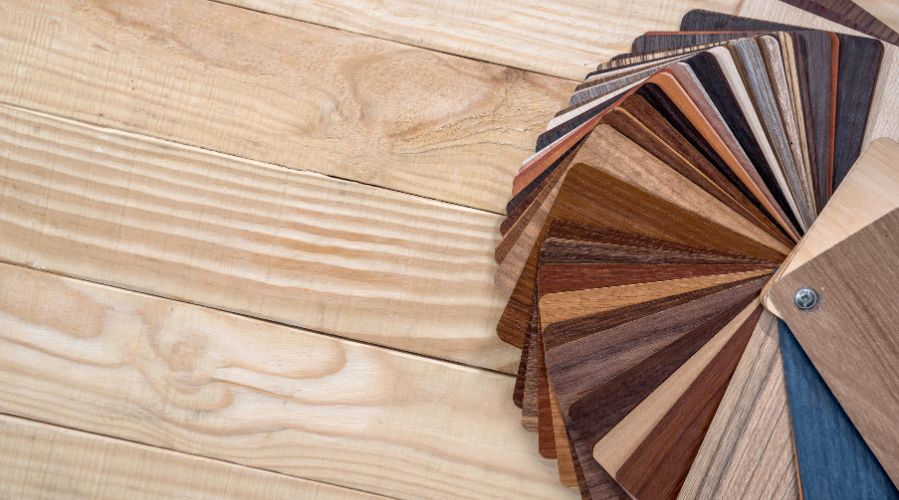
PVC laminate (Polyvinyl Chloride laminate) is a flexible, thin sheet made from synthetic plastic polymer. Unlike HPL, it’s not pressed paper — it’s a plastic-based film that’s either bonded to a substrate like MDF or plywood, or applied as a wrapping over pre-cut panels.
This flexibility is the biggest differentiator. PVC laminate can bend, wrap around edges, and conform to curved surfaces — which is why it’s the go-to choice for modular kitchen shutters, drawer fronts, and wardrobe panels in modern factory-made furniture.
PVC laminate is sometimes called PVC mica sheet in the Indian market — the two terms are used interchangeably by vendors and carpenters. They refer to the same product.
PVC Laminate vs Normal Laminate: Key Differences
Feature | PVC Laminate | Normal Laminate (HPL) |
|---|---|---|
Material | Plastic polymer (PVC) | Compressed paper + resin |
Flexibility | High — can wrap edges | Rigid — cannot bend |
Moisture resistance | Excellent | Good (but edges can swell) |
Heat resistance | Moderate | High |
Thickness | 0.18mm–1mm | 0.8mm–1.5mm |
Edge finishing | Seamless wrap possible | Requires separate edge banding |
Cost | ₹300–₹450 per sq ft | ₹250–₹400 per sq ft |
Best use | Modular shutters, curved panels | Flat surfaces, countertops |
Why Richwood Interio Uses PVC Laminate
This is the honest, practical reason — not a marketing answer.
In Mumbai and surrounding areas like Virar and Mira Road, humidity levels stay high for at least 5–6 months a year. Normal HPL laminate, when cut and installed by a carpenter, requires a separate PVC edge band to be glued along the edges. If that edge band isn’t applied perfectly — or if the adhesive weakens with moisture over time — water seeps into the substrate and the shutter starts to swell, bubble, or delaminate from the inside.
PVC laminate, on the other hand, is wrapped directly over the panel in a factory setting with precision machinery. The result is a seamless finish with no exposed edges — giving water no entry point.
Additionally, PVC laminates are:
- Factory-applied — no dependency on on-site carpenter skill
- Consistent in finish — no variation in texture or colour across shutters
- CNC-compatible — can be used on routed and shaped panels for modern kitchen designs
- Easier to replace — individual shutters can be swapped without redoing the entire kitchen
Our modular kitchen projects are designed and fabricated in our own factory — which means PVC laminate’s factory-friendly application is a natural fit for how we work.
PVC Laminate Moisture Resistance: Why It Matters for Indian Homes
Indian cooking is intense. Between the steam from pressure cookers, water splashes near the sink, and coastal humidity — your kitchen shutters take a beating that European kitchens simply don’t.
PVC laminate moisture resistance makes it the most practical surface for lower shutters, sink areas, and any kitchen where air conditioning isn’t always running. Combined with BWP (Boiling Water Proof) plywood or HDHMR as the substrate, a PVC laminate shutter can easily last 10–15 years without warping or swelling.
This is also why we factor moisture resistance into every material conversation during our complete home interior design process — because a beautiful kitchen that warps in 3 years is not good design.
PVC Laminate Price Per Sq Ft in India (2026)
One of the most common questions we get: “How much does PVC laminate cost?”
Here’s a realistic breakdown:
Type | Cost Range (₹/sq ft) |
|---|---|
Basic PVC laminate (solid colours) | ₹200–₹280 |
Mid-range PVC laminate (textures, wood grain) | ₹280–₹380 |
Premium PVC laminate (imported, high gloss) | ₹380–₹450 |
Normal HPL laminate (for comparison) | ₹150–₹400 |
Note: These are material costs. Fabrication, substrate, and fitting costs are separate and vary by project scope.
PVC Laminate vs Acrylic: Which Should You Choose?
If your budget allows, a popular question is whether to go with PVC laminate or acrylic for kitchen shutters.
Short answer: use both, strategically.
- PVC laminate for lower shutters (high use, water exposure, daily wear)
- Acrylic for upper shutters and feature walls (high visual impact, low daily contact)
This hybrid approach is exactly what we recommend — and explain in detail — in our blog on Acrylic vs Laminate vs PU vs Duco: Best Kitchen Cabinet Finish for Indian Homes
The cost difference is significant: acrylic runs ₹400–₹900 per sq ft vs PVC laminate at ₹200–₹450 per sq ft — so mixing finishes also keeps your overall kitchen budget in check.
PVC Laminate for Wardrobes Too
PVC laminate isn’t just for kitchens. It’s widely used for wardrobe shutters, study unit panels, and even TV unit carcasses — anywhere you need a clean finish that handles humidity and daily handling well.
If you’re planning a wardrobe alongside your kitchen, our Wardrobe Design Ideas for Indian Homes covers material, layout, and style options in detail.
What About PU Finish and Duco? How Does PVC Laminate Compare?
If you’re evaluating premium finishes, PVC laminate sits at the practical end of the spectrum — durable, affordable, and low-maintenance. PU and Duco finishes are paint-based and offer a more seamless, custom-colour look at a higher cost.
We cover this comparison fully in our blog on PU Finish vs Duco Finish: Difference, Cost & Which One is Right for Your Kitchen (link to new blog once published).
Richwood Interio’s Recommendation
If you’re building a modular kitchen in Mumbai, Virar, or Mira Road in 2026, PVC laminate is the most sensible base choice for your lower shutters and high-contact areas — regardless of your overall budget tier.
It’s durable, humidity-resistant, factory-finished, and available in hundreds of textures and colours that look anything but “budget.” When paired with a well-designed layout and quality hardware, a PVC laminate kitchen can look just as stunning as an acrylic one — and outlast it in real Indian conditions.
Richwood Interio — Premium Modular Kitchens & Interior Design in Virar, Mira Road & Mumbai. View our modular kitchen projects | See our portfolio | Contact us
Frequently Asked Questions
Normal laminate (HPL) is made from compressed paper and resin — it's hard and rigid. PVC laminate is a plastic-based film — flexible, moisture-resistant, and ideal for wrapping modular shutters without exposed edges.
Yes — it's one of the best choices for Indian kitchens due to its high moisture resistance, flexibility for edge wrapping, and durability against daily cooking wear and coastal humidity.
PVC mica sheet is simply another name for PVC laminate — commonly used by vendors and carpenters in Maharashtra and Gujarat. They refer to the same product: a flexible plastic-based decorative sheet applied to cabinet shutters.
PVC laminate costs between ₹200–₹450 per sq ft depending on the brand, texture, and finish quality. Basic solid colours are at the lower end; premium imported finishes are at the higher end.
Both serve different purposes. PVC laminate is better for lower shutters (durability, moisture resistance), while acrylic is better for upper shutters (high-gloss aesthetics). A hybrid approach using both gives you the best result.
Popular PVC laminate brands in India include Merino, Century, Greenlam, Durian, and Virgo. For imported options, Rehau and Egger are widely used in premium modular furniture.
When applied correctly with a sealed substrate (BWP plywood or HDHMR), PVC laminate does not swell or warp. Its key advantage over HPL is the seamless edge wrapping that prevents water entry.
Absolutely. PVC laminate is used across wardrobes, TV units, study tables, and storage units — anywhere a clean, durable, moisture-resistant surface is needed.
PVC is a synthetic plastic and is not biodegradable. However, it is recyclable and its long lifespan (10–15 years) means less frequent replacement — which offsets some environmental impact compared to lower-quality alternatives
We use PVC laminate as our primary shutter finish for modular kitchens — and recommend it for all our Mumbai-region clients due to the local humidity conditions. Get in touch with us to discuss the best finish for your specific kitchen layout and budget.