Interior Designer vs Contractor: Who Should Handle Your Complete Home?
It’s one of the first forks in every renovation: do you hire an interior designer, or hand the whole job to a contractor who quotes a lower number? On paper, the interior designer vs contractor question looks like a simple cost comparison. In practice, it decides how your home looks, how long the work takes, and how many problems land on your plate.
At Richwood Interio, we work with homeowners who have tried both routes. Here’s an honest look at interior designer vs contractor, including when a contractor is perfectly fine and when it isn’t.
What Does a Contractor Do?
A contractor executes work. Given a drawing, a list or a rough idea, they bring labour and materials to build it. They are skilled at civil work, carpentry, painting or electrical jobs, and often quote quickly and competitively. What they typically don’t provide is design: layout planning, material selection, colour coordination, lighting plans or 3D visuals.
What Does an Interior Designer Do?
A designer plans before anything is built. They study how you live, plan the layout and storage, choose materials and finishes, prepare drawings, and coordinate the trades. A firm like ours goes further, with an architect-led team that also executes, so the design you approve is the one you get. See our interior designing projects for how that works.
Interior Designer vs Contractor: Side-by-Side
| Factor | Contractor | Interior Designer (with execution) |
|---|---|---|
| Design and layout | Usually not included | Core part of the service |
| 3D visualisation | Rare | Standard before execution |
| Upfront cost | Often lower | Often higher |
| Material guidance | Limited | Detailed, based on your lifestyle |
| Coordination of trades | You manage it | Handled for you |
| Accountability | Per trade | Single point of responsibility |
| Best for | Simple, defined repairs | Complete homes and full renovations |
This table is the heart of the interior designer vs contractor decision: contractors build, designers plan and deliver.
Cost: Is a Contractor Really Cheaper?
Contractors often look cheaper because their quote covers labour and basic materials only. In the interior designer vs contractor debate, the gap narrows once you add what’s missing: design fees you pay elsewhere, mistakes that need redoing, mismatched finishes, and your own time managing trades. Cost also depends on how well the quote is written, so see how to compare three interior design quotes before you sign. For local numbers, our interior design cost in Virar breakdown is a useful reference.
Design Quality and Planning
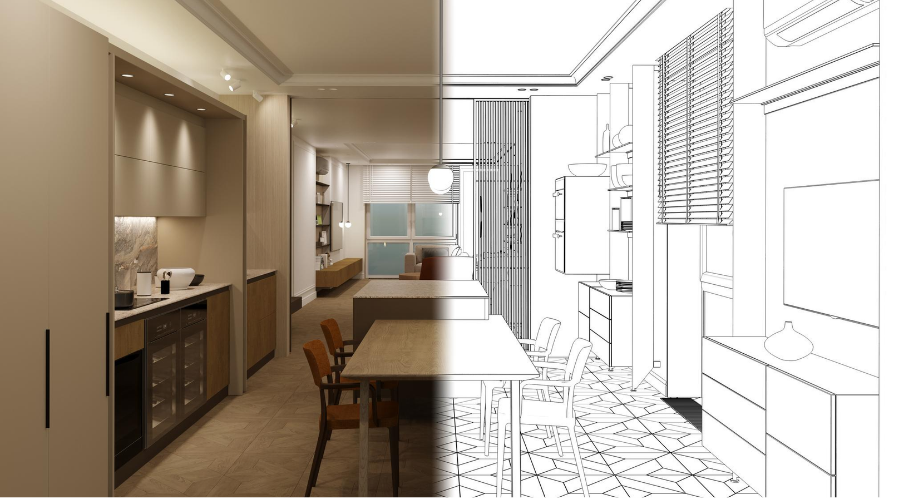
The biggest difference in interior designer vs contractor is what happens before work starts. A designer tests the layout on paper and in 3D, so problems appear in a drawing instead of in your finished kitchen. Our 2D & 3D design service lets you see your space before a single nail is hammered. A contractor working from a verbal brief leaves more to chance.
Materials and Finishes
Choosing the wrong board or finish is expensive to reverse. Designers guide these choices using durability, budget and climate. Our comparisons of PU vs Duco finish, PVC vs normal laminate and kitchen cabinet finishes show the kind of guidance you get. In Mumbai’s humidity, it matters as well, as explained in our post on whether plywood and MDF can get damaged during monsoon.
Timelines and Accountability
With a contractor, you often coordinate carpenters, electricians, painters and suppliers yourself. When something slips, responsibility is blurred. A design-and-execution firm owns the schedule end to end. Read how long an interior design project takes for realistic benchmarks, and see why choosing a turnkey approach over semi-furnished work can reduce delays.
Kitchens and Custom Furniture
Modular work shows the difference clearly. Factory-built units arrive precise and consistent, while on-site work depends heavily on the individual carpenter. We compare both in modular vs carpenter-made kitchens, and you can see how production works on our factory details page.
When a Contractor Is the Right Choice
To be fair, the interior designer vs contractor answer isn’t always “designer.” A contractor makes sense when:
- You need a single repair, repaint or minor civil fix
- You already have finished drawings and a clear specification
- The job is one room with no custom design involved
- You are happy to supervise the work personally
When You Should Hire an Interior Designer
Choose a designer for a complete home when:
- You are renovating a full 2BHK or 3BHK, as in our 2BHK and 3BHK interiors
- You want a cohesive look across rooms
- You want one accountable team rather than many vendors
- You value storage planning and space optimisation
- You prefer to see the design before it’s built
If you’re unsure how to pick, our guides on choosing the best interior designer for your home and the 5 mistakes homeowners make when choosing an interior designer in Mumbai will help.
The Middle Path: Design and Execution Under One Roof
Many homeowners find the best answer to interior designer vs contractor is a firm that does both. At Richwood Interio, design and execution sit with one team, backed by our own factory, so there’s no gap between what is drawn and what is built. Explore our turnkey interior projects or browse our portfolio.
Final Thoughts
For small, defined jobs, a contractor can be a sensible, economical choice. For a complete home, the interior designer vs contractor decision usually favours the designer, because planning, coordination and accountability prevent costly surprises. Ready to compare for your own home? Schedule a free consultation with our team.
Frequently Asked Questions
A designer plans the layout, materials and look of your home, while a contractor carries out the construction or installation work.
Often the initial quote is lower, but missing design, rework and self-managed coordination can narrow the gap.
Some can handle basic layouts, but most focus on execution and don't provide full design, 3D visuals or material planning.
For a complete home, a designer with in-house execution usually gives better planning and accountability.
For simple repairs, repainting, or a clearly defined single-room job where you already have drawings.
Many do, especially turnkey firms that manage design, procurement and execution together.
With a single design-and-execution firm, responsibility is clear. With separate contractors, it can be shared or disputed.
Usually yes, since one team coordinates all trades and follows a planned schedule.
Review completed projects, ask for an itemised quote and written agreement, and speak with past clients.
Architect-led turnkey firms like Richwood Interio provide design, manufacturing and execution under one roof.